
"You can't climb the mountain right if you're not climbing the right mountain."
How to Move Up When the Only Way Is Down
How To Move Up When The Only Way is Down
A well-paid executive feels trapped in her very respected but unsatisfying job. A startup founder has paying customers, but knows that unless he ‘fires’ them and pivots the business, his startup won’t make it. A single 30-something has been on dozens of dates and is pondering at what point to drop some of their perfect partner ‘must haves’. A coach, dependent on one star player, weighs whether to allow the rest of the team more field time to develop their skills but risk serious losses. A senior government planner is tasked with undoing the nation’s reliance on outdated infrastructure.
These are all examples of individuals stuck in a Local Maximum: a situation in which we’ve reached a peak, but not the one that fulfills the highest potential. In order to move up in our pursuits, we must first move back down - a realization which can lead to frustration, decision-making paralysis and lost opportunity.
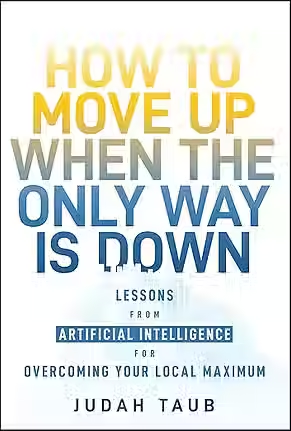
In How to Move Up When the Only Way Is Down: Lessons from Artificial Intelligence for Overcoming Your Local Maximum, Judah Taub draws from his perspective guiding early stage AI startups, his years serving in military intelligence where he developed a new kind of intelligence gathering, and his various experiences leading innovation throughout his career. Equipped with an off-the-beaten track perspective, Judah shares insights into how humans can achieve better decision-making to surpass expectations by learning from the way AI overcomes local maximums.
What tech engineers already know is that with the rise of AI, we’ve developed new ways of addressing these limitations. These techniques, employed to save billions of dollars for global giants like Amazon and Google, are equally applicable to each of us. The trick is to be open to learning from AI instead of just using or fearing it.
To show how, Judah shares a variety of real world examples, involving Olympic high jumpers, the transition of Ethiopian immigrants from gas station attendants to high tech engineers, the evolution of playing cards into Nintendo, the development of ChatGPT, methodology of US sport leagues vs European soccer, ant colonies’ ability to overcome ego, the link between wildfires and hedge fund managers - and much more.
The book explores:
-
How to anticipate and identify Local Maximums
-
How to overcome psychological Local Maximum blocks and biases
-
How to build skills and apply strategies to succeed in complex decision-making
-
How Local Maximum thinking can help overcome major global challenges
The book is equipped to benefit anyone facing complex decisions, or obstacles to their personal or professional goals. How to Move Up When the Only Way is Down is designed to transform readers’ decision-making by recognizing Local Maximums and skill building based on lessons from AI.

"Drawing his vantage point at the cutting-edge of Start-Up Nation and experience inside Israel's elite technology units, Judah Taub has a unique perspective on how to avoid the major pitfalls that everyone from starting entrepreneurs to big companies find themselves in. How To Move Up... offers a refreshing blueprint for tackling the toughest challenges in business and beyond."
Saul Singer
Author of Start-up Nation
“How To Move Up serves up an original take for leveraging creative thinking to overcome the decision-making traps we often set ourselves. By flipping the script - and learning from the methods AI uses to push through computational obstacles - the book reimagines how we can all do a better job achieving our true maximum potential.”
Scott Kupor
Managing Partner, Andreessen Horowitz & author of Secrets of Sand Hill Road: Venture Capital and How to Get It
“What got your business here won’t necessarily take it to the next level. Judah Taub guides you with fresh and creative insights from the worlds of tech and military intelligence so you can take your business to new heights.”
Joshua Margolis
James Dinan and Elizabeth Miller Professor of Business Administration,
Harvard Business School
In The Media


